
The 38th Bremen Cotton Conference 2026 will bring the industry together from March 25 to 27 at the Bremen Parliament. Three days full of insights, discussions, and networking: featuring a high-profile conference program, accompanying meetings, and ample space for intensive knowledge and information exchange.
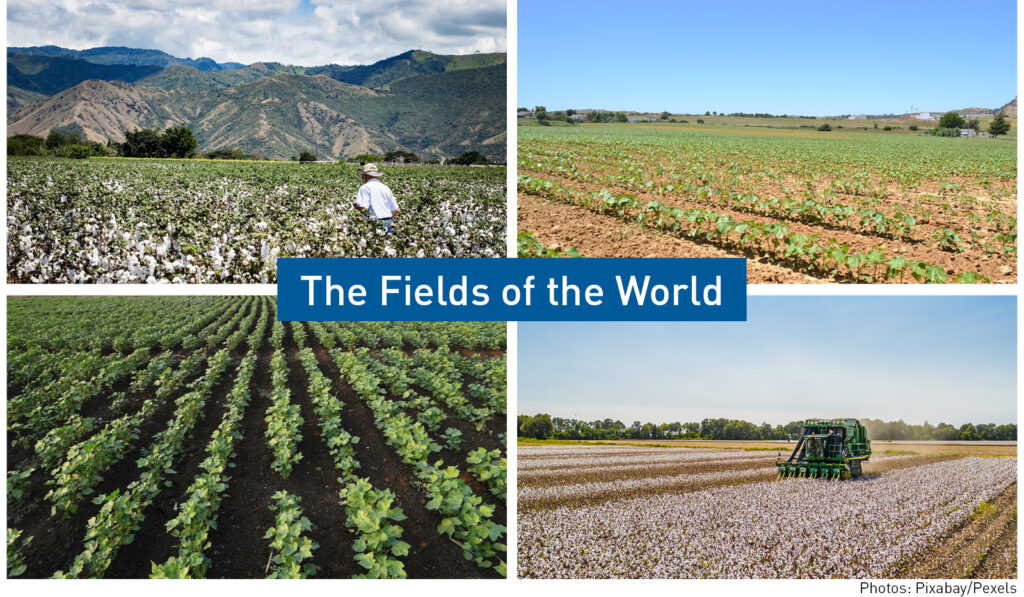
The Fields of the World: In the session “Cotton Production and Regions,” we turn our focus to the global landscape. The session highlights innovative cultivation approaches, strategies for adapting to climate change, new harvesting technologies, and sustainable fertilization concepts. It impressively demonstrates how different regions around the world respond to similar structural challenges – and which solutions are already paving the way for the future.
Focus on Cultivation Systems
Given limited water resources, alternative cotton cultivation systems are becoming increasingly important. Rebekah Ortiz-Pustejovsky from the Texas A&M Extension Service presents a recent study from one of the most important cotton-growing regions in the USA, examining how different planting parameters affect growth, yield, and fibre quality.
The field trials were conducted in Lamesa, Texas, using subsurface drip irrigation. The study analyzed plant growth, boll distribution, yield, and fibre quality (HVI, AFIS). Early results from two trial years clearly show that row spacing, planting density, and variety maturity significantly influence boll distribution and fibre quality. The study thus provides important, practical insights for efficient cotton management – particularly in semi-arid growing regions.
Cotton in Transition
Keshav Kranthi of the International Cotton Advisory Committee (ICAC) makes it clear: cotton is far more than just a fibre – it is a livelihood, an economic driver, and a key to sustainable development. In his presentation, he introduces a project in Cameroon that specifically aims to strengthen climate resilience, biodiversity, and income security for smallholder cotton producers.
The project is part of the Innovation Fund for Agriculture (i4Ag), initiated and funded by the German Federal Ministry for Economic Cooperation and Development (BMZ) and implemented by the Deutsche Gesellschaft für Internationale Zusammenarbeit (GIZ) GmbH. Its goal is to develop new approaches for resilient and sustainable cotton cultivation – and thereby create prospects for the people on the ground.
Challenges in Cotton Harvesting
In the third presentation of the session, Marinus van der Sluijs from Textile Technical Services, Australia, takes us on an exciting journey: the transition from manual to mechanized cotton harvesting.
A large portion of the world’s cotton is still picked by hand. However, this traditional method is increasingly reaching its limits. Labor shortages, rising costs, limited efficiency, and often low yields are putting many cotton-growing regions under pressure and intensifying the demand for mechanized solutions. The path toward mechanization, however, is far from straightforward – many initiatives so far have met with only moderate success.
Van der Sluijs highlights both earlier and current approaches, draws lessons from past experiences, and offers practical guidance for regions considering the shift to mechanized cotton harvesting. A presentation full of insights, experiences, and key impulses for the future of cotton cultivation.
Biochar in Cotton Production
What role can biochar-based fertilizers play in the quality of cotton fibres? This exciting question is the focus of a presentation by doctoral researcher Olouwakemi Sabirath Carine Oyatola from the University of Parakou in Benin. The early-career scientist investigates sustainable approaches to cotton cultivation and was already a guest in Bremen in March 2025 for research purposes. She now presents the results of a study conducted in northern Benin, which focused on how different combinations of biochar with organic and mineral fertilizers affect the technological properties of cotton fibres.
The results are promising: certain biochar-based fertilizer combinations can improve both fibre length and strength without negatively impacting other quality parameters. The positive effects are particularly pronounced in the more sensitive lower boll areas of the plant.
The study thus opens new perspectives – for higher fibre quality, more sustainable cultivation systems, and a stronger, economically viable cotton value chain in Benin.