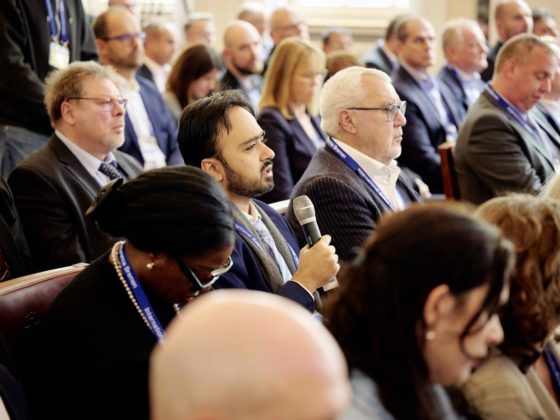
The International Cotton Conference Bremen will open on 25 March 2026 in the Parliament building of the Free Hanseatic City of Bremen with a keynote session of exceptional calibre. Distinguished international experts will set the stage for the conference by offering incisive perspectives on the most pressing challenges and the defining trends shaping the future of the global cotton trade.
Their insights will span a broad spectrum — from geopolitically driven disruptions affecting global supply chains to the opportunities emerging from innovation-led agriculture capable of supporting a growing world population. Together, these opening keynotes will frame the dialogue of the conference, highlighting both the complexity of today’s market environment and the pathways toward a resilient and forward-looking cotton sector.
Nils Haupt: When Trade Routes Turn Risky. How Geopolitics Pressures Logistics and Markets

Nils Haupt
Nils Haupt is a communications expert and Senior Director Corporate Communications at Hapag-Lloyd. Headquartered in Hamburg, Hapag-Lloyd is one of the world’s largest container shipping companies. His industry is under constant pressure: attacks on vessels, disrupted supply chains and geopolitical tensions are placing enormous strain on maritime logistics. Permanent alertness has become the new normal.
In his keynote, Haupt will explain how geopolitical upheavals are reshaping international trade flows and what this means for global markets. Security risks, interrupted supply chains and rerouting lead to longer transit times, rising costs and greater uncertainty — developments that directly affect availability, pricing and contract structures in the cotton trade.
As cotton is one of the most logistics-intensive agricultural commodities, delays and volatile sailing schedules have an immediate impact on producers, traders and spinning mills. Markets therefore react with particular sensitivity to political signals and media coverage. We are looking forward to welcoming Nils Haupt of Hapag-Lloyd and hearing his insights into these current developments.
Colin Iles: Rewriting the Cotton Trade. Economic Perspectives on a Shifting Market

Colin Iles
Colin Iles, Managing Director at ED&F Man Commodities, will explore current market and industry trends in the global cotton trade from an economic perspective – always with an eye beyond the immediate horizon.
As a seasoned market expert and long-standing industry leader, Colin Iles brings a clear and well-informed perspective on global developments. His keynote will focus on sound market analysis and precise strategic interpretation of current dynamics. In doing so, Iles connects macroeconomic conditions and key risk factors with practical options for companies and organisations across the entire cotton and textile value chain.
Against the backdrop of an environment shaped by economic disruption, geopolitical tensions and growing expectations regarding responsible business practices, we are eager to hear the trader’s perspective.
Andreas von Tiedemann: Does the future of crop protection still lie in chemistry?

Andreas von Tiedemann
With this question, Andreas von Tiedemann addresses one of the most sensitive issues in the public debate. Von Tiedemann is an agricultural and environmental scientist and has been Professor of Plant Pathology and Crop Protection at the University of Göttingen since 2001.
Crop protection is often controversial and frequently viewed in a negative light. Public debate often lacks the level of understanding needed for a fully informed opinion. Agricultural practice shows that modern crops, including cotton, cannot deliver stable yields without effective crop protection. Despite its high efficiency and its role in securing supply, modern agriculture is often criticised. From a scientific perspective, crop protection, adapted varieties and suitable cultivation systems are essential to safeguard yields and avoid supply crises.
According to von Tiedemann, political frameworks should be shaped far more strongly by evidence. The goal of crop protection is not maximum intensity, but the safeguarding of stable yields while keeping environmental impacts within acceptable limits. His conclusion is therefore clear: anyone who broadly delegitimises crop protection is putting food security at risk — not in theory, but in very concrete terms.
Cotton 2026: Understanding challenges, shaping the future
The keynote session of the 38th International Cotton Conference Bremen makes clear just how complex and interconnected the challenges facing the cotton sector have become. Economic transformation, geopolitical risks and societal expectations regarding responsible practices cannot be viewed in isolation. They require an integrated understanding of market mechanisms, supply chains and agricultural realities.
The keynotes demonstrate that future viability emerges where economic realities, scientific evidence and transparent communication are brought together. From the very beginning, the Bremen conference thus creates a framework for fact-based analysis, international perspectives and solution-oriented dialogue. It offers an ideal platform for exchange and networking and invites decision-makers, experts and practitioners to discuss the future of cotton together and help shape it actively.
ICAC Plenary in Bremen
The ICAC Plenary Meeting brings together the entire global cotton and textile value chain — from production to retail — in a high-level forum. Through dedicated sessions on research, production, markets, textiles and trade, it connects senior policymakers from ICAC member governments with industry leaders to ensure that policy discussions reflect the real needs of the sector.
The Plenary also highlights cotton’s role as a global public good by emphasizing its economic, social and environmental importance worldwide:
https://icac.org/meetings/83rd-plenary-meeting-bbb